Joe Ajaero insists the NLC can negotiate alone, challenging the TUC’s position amid a dispute over workers’ N70,000 transport allowance
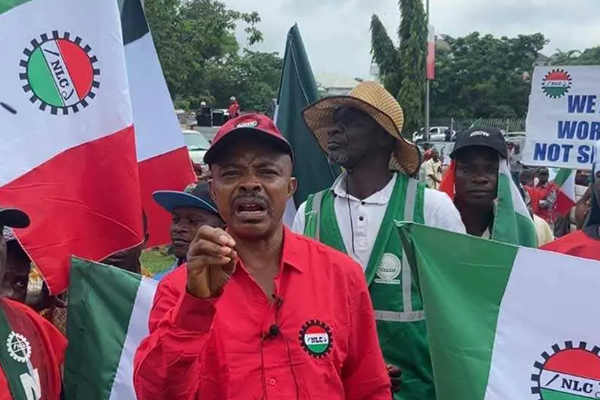
The President of the Nigeria Labour Congress (NLC), Joe Ajaero, has insisted that the labour centre has the authority to negotiate independently on workers’ welfare matters, rejecting a position by his Trade Union Congress (TUC) counterpart, Festus Osifo, that both organisations must participate in such negotiations.
Ajaero said the TUC could take part in negotiations alongside the NLC but could not independently engage labour authorities on workers’ issues.
He based his position on what he described as the International Labour Organisation’s principle of recognising the majority representation of workers.
The NLC president made the remarks on Monday during an appearance on Channels Television’s ‘The Morning Brief’, amid a disagreement between the two labour centres over the Federal Government’s N70,000 transport allowance approved for workers across all levels for six months.
“TUC can negotiate along with NLC but NLC can negotiate alone based on the principle of most workers representatives of the ILO,” Ajaero said.
He further argued that the TUC was expected to submit its proposals through the NLC when dealing with the International Labour Organisation.
According to Ajaero, the TUC had previously submitted its negotiation proposals independently ahead of an ILO conference, but the submission was returned for onward processing through the NLC.
“They have to send their list here for me to forward it; that is the position of the ILO. NLC determines how TUC participates,” he said.
Ajaero maintained that the Ministry of Labour and other government labour authorities would not independently negotiate workers’ welfare matters with the TUC.
“TUC can’t negotiate alone; if they are saying and it is implied, it does not happen. I don’t think the Ministry of Labour or the Labour Authority will allow that to happen,” he added.
Addressing Osifo’s argument that the TUC represents a significant number of workers in the federal civil service, Ajaero referred to the Trade Union Amendment Act 2005 and Section 40 of the 1999 Constitution, which he said protect workers’ freedom to choose their unions.
He argued that trade union membership was voluntary and that individual workers had the right to decide which labour organisation they wished to join.
“The 2005 Trade Union Amendment Act made membership of trade unions voluntary,” he said.
Ajaero also cited Section 40 of the Constitution, arguing that it guarantees Nigerians the right to belong to associations and unions of their choice.
The NLC president further challenged the TUC’s claim about its level of representation in the Joint National Public Service Negotiating Council.
He said only one of the eight union bodies within the joint council was affiliated with the TUC, while the remaining seven belonged to the NLC.
He also claimed that the TUC-affiliated union had subjected its powers to the joint council.
Explaining the circumstances surrounding the N70,000 transport allowance, Ajaero said the agreement followed pressure from the NLC after it issued an ultimatum to the Federal Government.
He disclosed that the government requested four days to meet with labour leaders, after which discussions resumed and the transport allowance was agreed upon.
“We gave government an ultimatum; we were supposed to start an action. The government asked for four days and to meet with us, and we met, and they resumed sitting after four days,” he said.
“After the meeting, the 70k allowance came up.”
Ajaero also maintained that negotiations over the national minimum wage required the government to establish a negotiation committee before formal demands could be presented.
He said wage-related decisions required consultations involving labour representatives, government officials and employers, underscoring the need for structured negotiations between the parties.







 news1 year ago

 politics1 year ago

 entertainment2 years ago

 entertainment2 years ago

 politics2 years ago

 politics1 year ago

 events2 years ago

 events2 years ago