An American man, Francis Kaufmann, has been sentenced to life imprisonment in Italy for murdering his 28-year-old Russian partner and their 11-month-old daughter, whose bodies were discovered in a park in Rome.
Kaufmann, 47, was convicted on Thursday, November 5, 2026, by a court in the Italian capital over the deaths of Anastasia Trofimova and their daughter, Andromeda.
The court also sentenced him to three years of daytime solitary confinement as part of the punishment for the double murder.
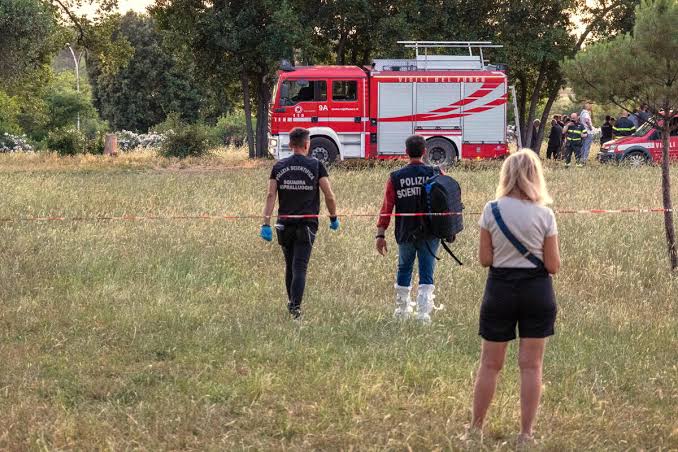
The bodies of the victims were discovered in June 2025 at Villa Pamphili, a public park in Rome, after the mother and child had been reported missing.
Investigators found Trofimova’s body beneath a black bag, while her daughter’s remains were discovered in nearby undergrowth. The bodies were found several metres apart on June 7, 2025.
Prosecutors told the court that Trofimova had been killed several days before her daughter.
They also presented CCTV footage which allegedly showed Kaufmann carrying the infant towards the park before returning about an hour later without her.
According to the prosecution, the evidence established that Kaufmann was responsible for both deaths.
Kaufmann, however, denied murdering his partner and daughter throughout the trial. His defence lawyer, Paolo Foti, argued that the case relied largely on circumstantial evidence and maintained that the prosecution had not presented direct proof linking his client to the killings.
Despite the defence’s arguments, the court found him guilty and handed down the life sentence.
Following the discovery of the bodies, Kaufmann left Italy and travelled to the Greek island of Skiathos, where he was arrested on June 13, 2025, under a European arrest warrant before being extradited to Italy to face trial.
The defendant, who was born in California, also used the name Rexal Ford and presented himself as a film director and producer.
The case attracted further attention because of revelations surrounding his alleged activities in Italy’s film industry. Kaufmann had reportedly secured nearly $1m in Italian tax credits for a film project that was never produced.
The controversy surrounding the funding led to the resignation of a senior official in Italy’s Culture Ministry’s film department.
Meanwhile, the investigation into the deaths received a major breakthrough after the case was featured on an Italian television programme that seeks public assistance in locating missing people and identifying unknown victims.
Information provided by a viewer helped investigators revisit an earlier police encounter involving Kaufmann, Trofimova and their child.
Police records also showed that Kaufmann had been stopped on June 5, 2025, while alone with the infant. Prosecutors said Trofimova was already dead at the time and suggested that earlier intervention might have saved the child.
Trofimova had reportedly met Kaufmann in Malta in 2023 before they moved to Rome with their daughter.
The verdict brings a major development in a case that shocked Italy, although Kaufmann’s defence lawyer indicated that the decision was expected to be appealed.
Under the Italian legal system, defendants can challenge first-instance convictions through two levels of appeal.



 news1 year ago

 politics1 year ago

 entertainment2 years ago

 entertainment2 years ago

 politics2 years ago

 politics1 year ago

 events2 years ago

 events2 years ago